


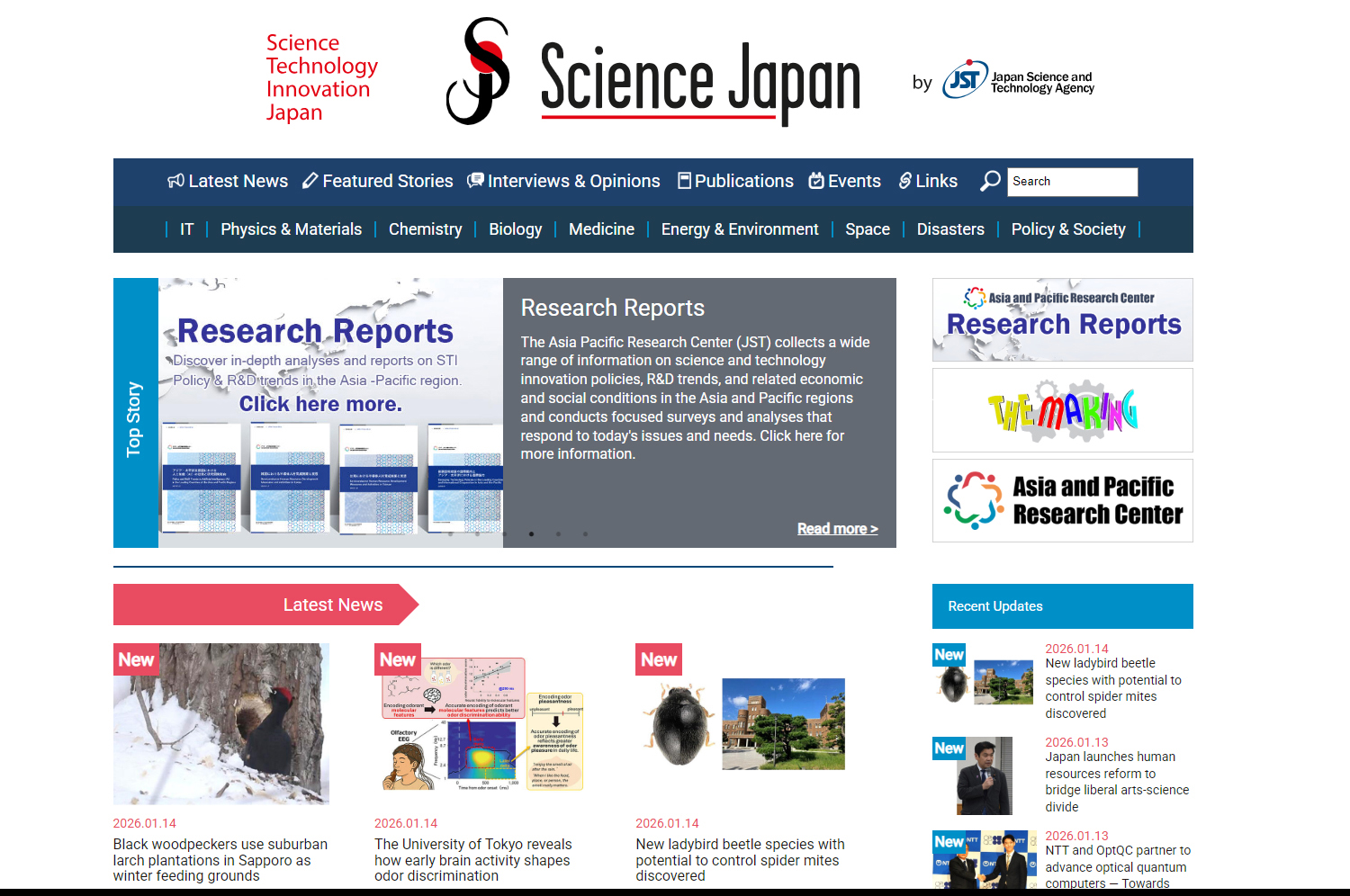
As Japan leverages its capabilities as a global science and technology leader, Science Japan, an English-language website published by the Japan Science and Technology Agency, is promoting international exchange and increased scientific collaboration between Japan and other countries in the Asia and Pacific regions by providing international readers with a window onto the latest research and innovation breakthroughs in Japan.

One field that has been making headlines is artificial intelligence, and JST has been overseeing funding for research projects that use AI systems to recognize subtle patterns within enormous data sources, leading to new discoveries. These include projects to identify previously undetected earthquakes, propose new chemical catalysts, locate genetic targets for cancer treatment, identify invasive animal species by sound, and develop coordinated AI agents that can communicate and cooperate effectively to handle complex business tasks. There have also been breakthroughs in training AI to imbue robots with more expressive, human-like motions. More stories about AI research in Japan can be found on the Science Japan website.

JST is also working to carry out the goals of the government’s national science plan, the sixth since 1996. Known as the Science, Technology, and Innovation Basic Plan, this 2021 directive encourages international collaboration to achieve solutions to global issues and maximize knowledge through diverse ideas and capabilities. As part of this plan, JST has been promoting the formation of what it calls an “international brain circulation network” — an environment where scientists and researchers from different countries and backgrounds can both compete and collaborate, which JST considers a prerequisite for robust research and development.
As part of its coverage of international brain circulation, Science Japan interviewed Nicholas Smith, an Australian biophotonics researcher working in Japan. He discussed the field of photonics, its applications in immunology and how international brain circulation has contributed to his career as a researcher. Stories on this and other researchers from the Asia and Pacific regions working on similarly cutting-edge projects in Japan can be found at Science Japan.

